How Palestinian tatreez and Ukrainian vyshyvanka, two cross-stitch traditions from opposite corners of the world, meet in the stitched band that runs through SimSim's design.
Look at the stitched band that runs across the top of this site, or the small stitched marker beside a dish on our menu page, and you are looking at the same argument the whole restaurant is trying to make. Palestinian tatreez and Ukrainian vyshyvanka are usually filed under separate headings, one a craft of the Levant, the other of Eastern Europe, but set them side by side and the resemblance is impossible to miss. Both are counted cross-stitch, worked by hand onto even-weave cloth, one X at a time, building geometric motifs that carry meaning across generations rather than just decorating a hem. We did not set out to force a connection between our two cuisines. We set out to notice one that was already there, then let it run through our site, our menu, and the smallest details of our brand.
One Stitch, Two Vocabularies
Cross-stitch is a technique before it is a style, and that is the part that makes tatreez and vyshyvanka cousins rather than coincidences. Stitchers in both traditions count threads on the fabric itself rather than following a printed pattern, building shapes from a single repeating X worked in careful rows. The vocabulary that grows out of that technique turns out to be remarkably similar too: trees, flowers, birds, and diamonds, repeated and mirrored into borders, each motif carrying a name and a meaning particular to the village or region that stitched it. Two women on opposite sides of the world, working the same stitch with no knowledge of each other, arrived at a shared grammar for turning thread into story.
What Tatreez Says
In Palestinian tatreez, the motifs stitched onto a thobe once told you where a woman was from before she said a word: a cypress tree from one village, a moon from another, a pattern of stars from a third. Deep reds, worked most often in silk floss on black or indigo linen, dominate the older pieces, though color and motif both shift by region and by occasion. It is an embroidery of place, a map of home stitched close enough to wear.
What Vyshyvanka Says
Ukrainian vyshyvanka carries the same idea in a different climate. The embroidered shirt that gives the tradition its name, and the long ceremonial cloths called rushnyky, are worked most traditionally in red and black, red for life and joy, black for the earth, with motifs of wheat, poppies, and the sun standing in for a landscape of open fields rather than hills. Like tatreez, the patterns vary by region closely enough that, to someone who reads them, a finished piece names a home the way an accent does.
The Seam Running Through Our Design
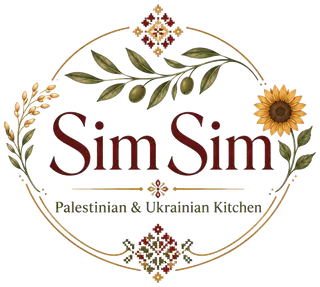
Once you set those two vocabularies next to each other, the design of this restaurant stops feeling like a choice and starts feeling like the only honest option. The stitched band that runs through our design starts red on black at one end and finishes blue on black at the other, and instead of a hard line where the two traditions meet, the thread passes through a shared red seam in the middle, the same red both traditions already spoke on their own. Look closely as you move through the site, and you will find:
- The full band itself, red-on-black tatreez giving way through the shared seam to blue-on-black vyshyvanka
- An olive branch worked into the Palestinian half, echoing the groves of the Levant
- A spray of wheat worked into the Ukrainian half, echoing the fields of Eastern Europe
- A single stitched diamond, the same motif in miniature, used to mark a dish's heritage on the menu itself
- A sunflower, the one motif drawn large enough to belong to both halves at once, tying the whole band together as one field instead of two
Why We Stitched Them Together
We could have hung one tradition on one wall and the other on the opposite wall and called it balanced. We did not, because that is not what this kitchen is. Tatreez and vyshyvanka did not develop side by side; they grew up continents apart, in answer to different landscapes and different histories. Stitching them into one continuous band, sharing one seam, is our way of saying the same thing our menu already says every night: these are two full, distinct culinary traditions, given equal weight at the same table, not a fusion of the two and not a menu of two halves stapled together. The thread is the clearest version of that idea we know how to make, and it is the first thing we built before a single dish went on a plate.
It also means the embroidery keeps teaching you something new the longer you look. A first visit might only register the color shift from red to blue. A second visit finds the olive branch. A third finds the wheat, then the sunflower holding the whole thing together. That slow reveal is very close to what we hope happens at the table too, one dish from each side of the seam, until the two stop feeling like two.
Before your next visit, follow the stitched band across our menu page the whole way from red-on-black to blue-on-black, and look for the small stitched diamond beside each dish: red marks the Palestinian side of the table, blue the Ukrainian. Reserve your table and see where the thread leads.