
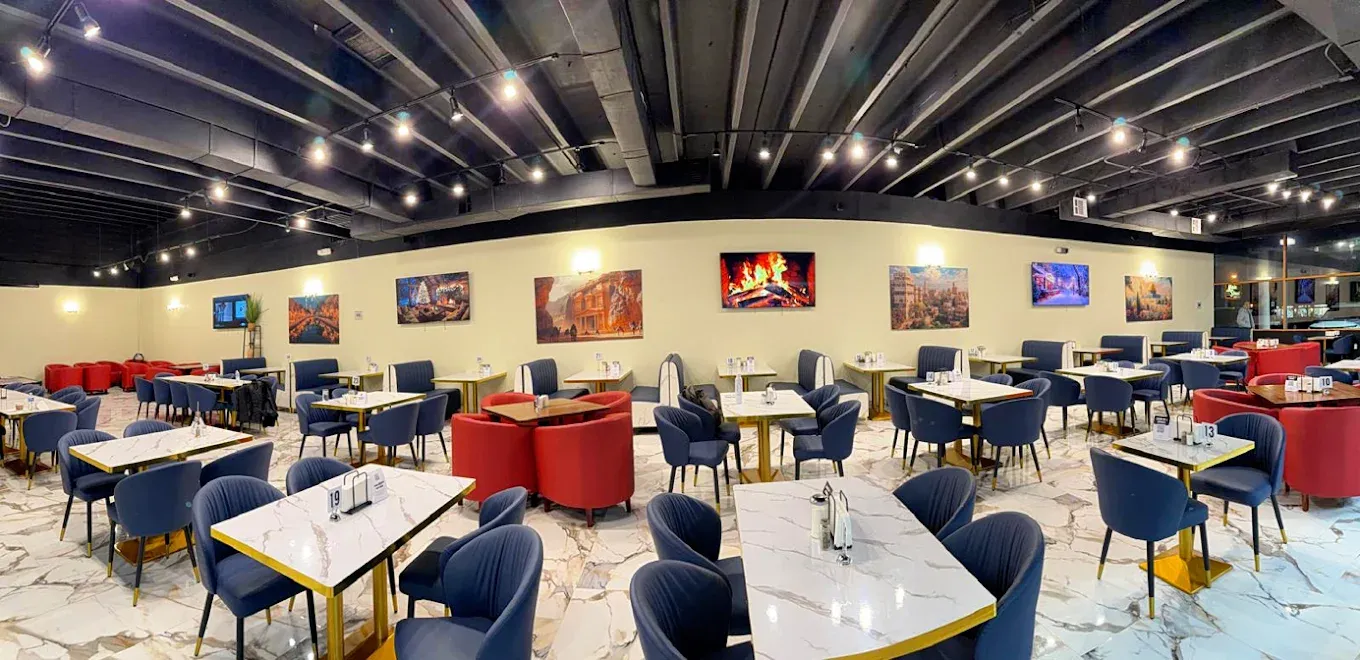
A short history of skewered, fire-grilled meat from the Central Asian steppe through the Ottoman Empire and the Levant, and how that same tradition reached our own grill in Fairfax.
Long before restaurants, before iron grates, before anyone wrote a recipe down, someone speared a piece of meat on a stick and held it over a fire. That single gesture is the whole idea behind the kebab, and it is old enough that no one kitchen, army, or empire can rightly claim it as an invention. What we can trace is the road it traveled, through the grasslands of Central Asia, through the medieval kitchens of Persia and Baghdad, through the courts and garrison towns of the Ottoman Empire, into the home kitchens of the Levant, before it ever reached our own grill in Fairfax. It needed no plates, no table, and no permission from any one culture to belong to it.
A Cook's Answer to Open Country
Skewered meat most likely began as practical cooking for people on the move, Turkic and Central Asian herding communities who needed a fast, fuel-efficient way to cook without hauling pots or ovens across open country. A blade, a green branch, or a metal rod threaded with cubes of meat and held directly over embers turned a small fire into a full meal in minutes. That efficiency is exactly why the technique spread so widely: it asked for almost nothing, fire, meat, and something straight to thread it on, and almost anyone could do it well. Even the word traveled that easily. Kabap, kebap, kabob, kebab: the name was picked up and reshaped by each language it passed through, the same way the dish itself was reshaped by each fire it met.
An Empire That Carried the Fire With It
When this style of cooking reached the Ottoman court and its provincial kitchens, it did not stay a single dish, it multiplied. Ottoman cooks refined the technique into a whole category: ground meat pressed onto flat skewers, cubed meat threaded whole, meat grilled low over coals, and, most likely developed in Bursa's kitchens in the nineteenth century before it spread to the capital and beyond, meat stacked in layers and roasted upright on a turning spit. Because the Ottoman Empire spanned three continents and several centuries, its versions of skewered, fire-grilled meat traveled outward with soldiers, traders, and administrators, along caravan routes and through garrison towns, into the Balkans, North Africa, the Caucasus, and the Levant. Every region that received it added its own hand: its own spice shelf, its own cut of meat, its own name for the result, until a technique built for the road became a fixture of markets and family tables from one end of the empire to the other.
The Levant Makes It Its Own
In Palestinian kitchens, this tradition settled into a particular character of its own, built on lamb and beef, seasoned with warm spice rather than heat, and cooked hard and fast over live coals so the outside caramelizes while the center stays tender. Two techniques did most of the work of making it local: hand-formed ground meat pressed around a flat skewer, and whole cubes of meat threaded and grilled until the edges char. Sharing several skewers off one platter, rather than portioning a single cut per plate, became as much a part of the tradition as the fire itself. Both approaches anchor our own grill today. Our lamb kofta and chicken kofta carry the ground tradition forward; our lamb kabob and beef kabob carry the cubed one; and our lamb chops apply the same open-fire logic to a cut that never needed a skewer to belong at the same fire.
A Second Fire, From a Different Direction
Skewered, open-fire grilling did not travel toward Eastern Europe only through Ottoman lands. A parallel current moved north through the Caucasus and the steppe above the Black Sea, where communities built their own marinated, fire-grilled meat traditions long before they became a fixture of outdoor cooking across Ukraine and its neighbors. It is a smaller thread than borshch or varenyky in the larger story of Ukrainian food, but it matters here: the idea of threading meat and standing it over open coals was never foreign to either half of our kitchen. It simply arrived by two different roads and settled into two different pantries of spice, which is part of why one shared grill makes so much sense on our menu.
What We Grill Today
Every skewer that comes off our fire is a small piece of that longer story, cooked the way it has always been cooked, hot, fast, and close to the flame. Our grill carries the family in full:
- Lamb Kofta and Chicken Kofta, hand-formed ground meat, the oldest shape this tradition took
- Lamb Kabob and Beef Kabob, cubed meat threaded whole and grilled over open coals
- Chicken Shish Taouk and Whole Chicken Tikka, marinated poultry brought to the same fire
- Lamb Chops, the same fire-forward principle applied to a cut that never needed a skewer
- Mix Grill, three kebabs on one platter, for anyone who wants to taste the whole family at once
Come taste centuries of open-fire cooking in one sitting. Order the Mix Grill and follow the kebab's whole journey across three traditions, three kebabs, one platter, one fire.